

TABLE OF CONTENTS (TOC)
- Introduction: Understanding the Importance of Bearing Selection
- What Are Bearings and Why Are They Critical?
- Overview of Rolling Element Bearings
- What Are Ball Bearings?
4.1 Construction
4.2 How Do They Work
4.3 Advantages
4.4 Limitations - What Are Roller Bearings?
5.1 Construction
5.2 How Do They Work
5.3 Advantages
5.4 Limitations - Types of Ball Bearings
- Types of Roller Bearings
- Comparison Table
- Automotive Applications of Ball and Roller Bearings
- Industrial and Heavy Machinery Applications
- Maintenance Requirements and Bearing Lifespan
- Common Failures Caused by Wrong Bearing Selection
- How to Choose the Right Bearing for Your Application
- Cost Comparison and Long-Term Value Analysis
- Future Trends in Bearing Technology
- Final Verdict
- Conclusion
A Complete Technical & Practical Guide for Automotive and Industrial Applications
Why the Right Bearing Choice Matters More Than You Think?
Bearings are often considered small, standard mechanical components, yet they are among the most critical parts in any rotating system. From automobiles, electric motors, and gearboxes to industrial machines and heavy equipment, bearings determine how smoothly, efficiently, and reliably a system operates.
Two of the most widely used bearing types across industries are ball bearings and roller bearings. At first glance, they may appear interchangeable, but in reality, choosing the wrong bearing type can lead to excessive friction, overheating, vibration, premature failure, and costly downtime.
For manufacturers, engineers, mechanics, and business owners, understanding the difference between these two bearings is essential. The correct bearing selection improves performance, reduces maintenance costs, and significantly extends equipment life.
This in-depth guide explains how both bearing types work, their structural differences, load and speed capabilities, advantages, limitations, real-world applications, maintenance requirements, and how to choose the right bearing for long-term reliability.
Understanding Bearings and Their Role in Mechanical Systems
Now, let us firstly understand what bearings are, and how it helps us in the Mechanical automotive industry.
Bearings are mechanical elements designed to support moving parts while reducing friction. Their main purpose is to allow controlled motion—usually rotation—while carrying loads efficiently.
Key functions of bearings include:
The following points provided are some of the useful and vital functions of bearings in the motor parts industry-
- Supporting rotating or oscillating shafts
- Reducing friction between moving components
- Carrying radial and axial loads
- Maintaining precise alignment
- Improving energy efficiency
- Minimizing wear and tear
Without bearings, metal-to-metal contact would cause rapid damage, heat generation, and system failure. In high-speed or heavy-load applications, the importance of proper bearing selection becomes even more critical.
Rolling Element Bearings: An Overview
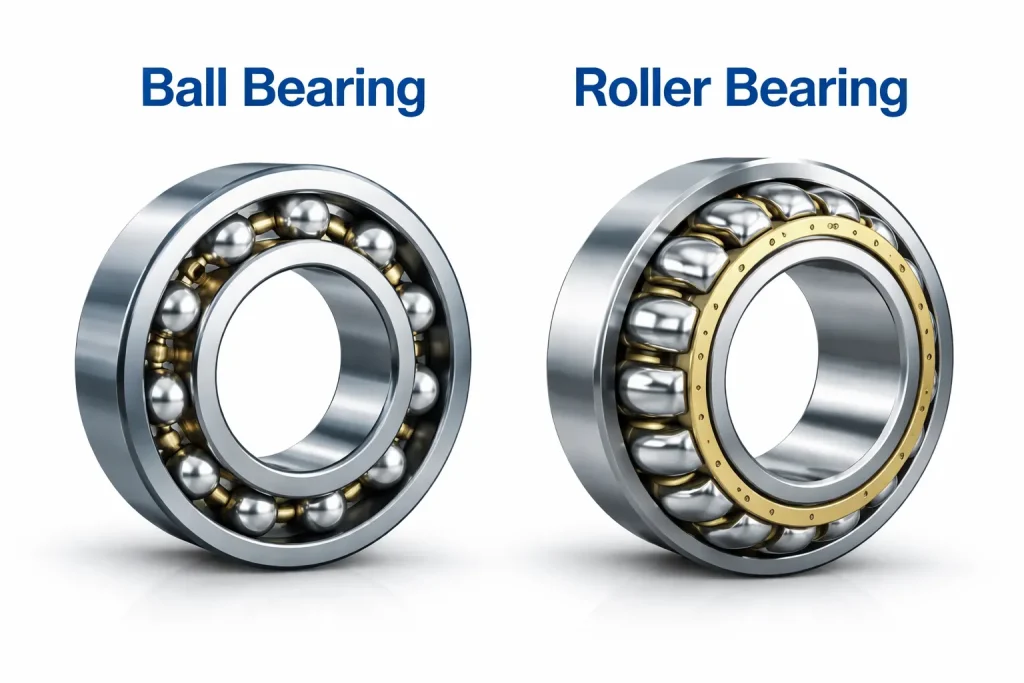
Ball bearings and roller bearings both fall under the category of rolling element bearings. These bearings reduce friction by replacing sliding motion with rolling motion using rolling elements placed between the inner and outer rings.
The shape of the rolling element determines how loads are distributed:
- Ball bearings use spherical balls, whereas
- Roller bearings use cylindrical, tapered, spherical, or needle-shaped rollers
This fundamental difference affects load capacity, speed capability, friction, noise, and durability.
What Are Ball Bearings?
Ball bearings are one of the most common bearing types used across automotive, industrial, and consumer applications. They use hardened steel or ceramic balls placed between inner and outer raceways.
How Are They Constructed?
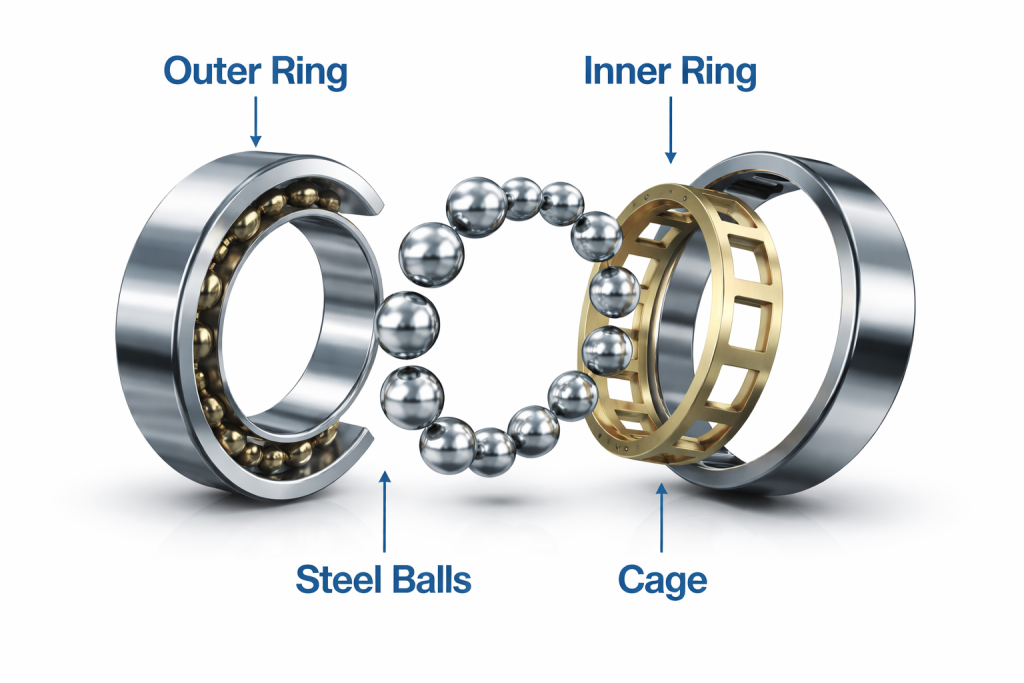
A standard ball bearing consists of:
- Inner ring (mounted on the shaft)
- Outer ring (mounted in the housing)
- Balls (rolling elements)
- Cage or separator (keeps balls evenly spaced)
- Lubrication (grease or oil)
The precision of raceways and ball geometry allows smooth, consistent rotation.
How Does The Ball Bearing Work?
They operate on point contact. Each ball touches the raceway at a very small contact point. This minimizes friction and allows the bearing to rotate at very high speeds with minimal resistance.
Because of this design, they generate less heat and consume less energy compared to many other bearing types.
What Are Their Advantages?
The following key points offer several performance benefits about them:
- Excellent high-speed capability
- Low friction and reduced energy loss
- Smooth and quiet operation
- Compact and lightweight design
- Lower torque requirements
- Minimal maintenance in many applications
- Cost-effective for mass usage
These advantages make ball bearings ideal for applications where speed, efficiency, and noise control are important.
What Are The Limitations of Ball Bearings
Despite their benefits, there are some limitations to them:
- Lower load-carrying capacity
- Less resistance to shock and impact loads
- Risk of ball deformation under excessive load
- Not suitable for very heavy industrial applications
Ball bearings perform best under light to moderate loads.
What Are Roller Bearings?
Roller bearings use rolling elements in the form of rollers instead of balls. These rollers may be cylindrical, tapered, spherical, or needle-shaped, depending on the application.
How are They Constructed?
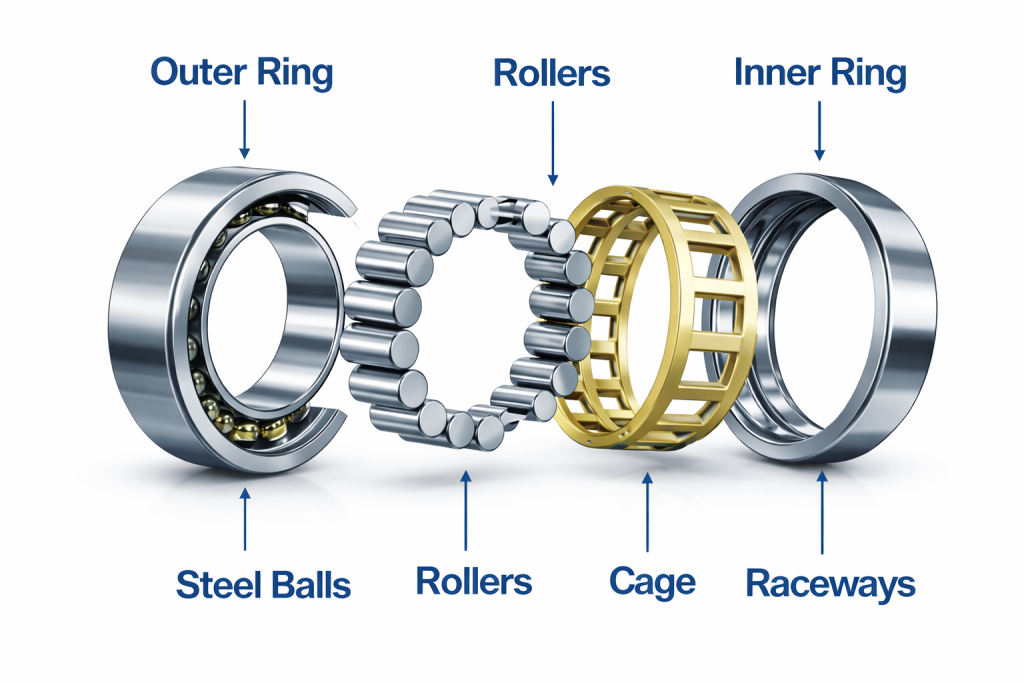
The following materials are the mechanical parts that help these bearings function:
- Inner ring
- Outer ring
- Rollers
- Cage
- Lubrication system
The rollers provide a larger contact surface with the raceways.
How Do They Work?
Roller bearings operate on line contact rather than point contact. This allows the load to be distributed over a larger surface area, reducing stress concentration and enabling the bearing to handle heavier loads.
This design makes roller bearings stronger and more durable under demanding conditions.
What are the Advantages?
Roller bearings are preferred for their strength and durability:
- High radial load-carrying capacity
- Excellent resistance to shock and impact
- Long service life under heavy loads
- Suitable for harsh operating environments
- Better performance in misaligned systems (specific types)
Their Limitations
Other than advantages, the Roller bearings also have some drawbacks:
- Higher friction compared to ball bearings
- Lower maximum speed capability
- Larger and heavier design
- Higher lubrication and maintenance requirements
- Generally higher initial cost
They are designed primarily for strength over speed.

Types of Ball Bearings
Different ball bearing designs serve different applications:
Deep Groove
The most widely used type; suitable for radial and moderate axial loads.
Angular Contact
Designed for combined radial and axial loads; often used in pairs.
Self-Aligning
Allow misalignment between the shaft and housing.
Thrust
Designed to handle axial loads only.
Types of Roller Bearings
Roller bearings also come in multiple forms:
Cylindrical
High radial load capacity with moderate speed capability.
Tapered
Handle combined radial and axial loads; common in automotive hubs.
Spherical
Allow misalignment and handle very heavy loads.
Needle
Compact design with high load capacity.
Comparison Table: Ball Bearings vs Roller Bearings
| Feature | Ball Bearings | Roller Bearings |
|---|---|---|
| Load Capacity | Light–Moderate | Heavy |
| Speed Capability | High | Medium–Low |
| Friction | Low | Higher |
| Noise Level | Low | Moderate |
| Shock Resistance | Low | High |
| Size | Compact | Larger |
| Energy Efficiency | High | Moderate |
| Maintenance | Low | Moderate–High |
Automotive Applications of Ball and Roller Bearings
In the automotive industry, both bearing types are used extensively:
Ball Bearings in Automobiles
- Electric motors and EV drivetrains
- Alternators
- Cooling fans
- HVAC systems
Roller Bearings in Automobiles
- Wheel hubs
- Transmissions and gearboxes
- Axles and differentials
Incorrect bearing selection in vehicles can compromise safety, comfort, and fuel efficiency.
Industrial and Heavy Machinery Applications
In industrial settings, roller bearings dominate heavy machinery such as:
- Conveyors
- Crushers
- Mining equipment
- Steel mills
Ball bearings are preferred in high-speed industrial equipment like CNC machines, compressors, and pumps.
Bearing Maintenance and Service Life Comparison
Ball Bearings
- Require minimal lubrication
- Lower maintenance cost
- Longer life in high-speed environments
Roller Bearings
- Require regular lubrication
- Periodic inspection needed
- Longer life under heavy load conditions
Proper installation and contamination control are critical for both.
Impact of Bearing Choice on Energy Efficiency
The selection between the two bearings has a direct impact on energy efficiency in rotating machinery. Ball bearings generate lower friction due to point contact between the balls and raceways, making them more energy-efficient in high-speed applications such as electric motors, fans, and light automotive components. Roller bearings, on the other hand, have line contact, which increases load capacity but also results in higher friction under certain conditions.
In industrial environments where machinery operates continuously, even a small increase in friction can lead to higher energy consumption and operational costs. Therefore, choosing the correct bearing type based on speed and load requirements plays a crucial role in reducing power losses and improving overall system efficiency.
Bearing Performance Under High-Speed Applications
High-speed performance is one of the most critical factors when comparing these two bearings. Ball bearings are specifically designed to perform efficiently at higher rotational speeds because the rolling elements experience less resistance during motion. This makes them ideal for applications such as automotive alternators, electric vehicle motors, and HVAC systems.
Roller bearings, while excellent for handling heavy loads, are generally limited in speed capability due to increased heat generation caused by larger contact areas. Using roller bearings in high-speed environments without proper lubrication and heat management can result in premature failure, making ball bearings the preferred choice for speed-driven applications.
Load Distribution and Structural Stability
One of the main reasons roller bearings are widely used in heavy-duty machinery is their superior load distribution capability. Unlike ball bearings, which support loads at specific contact points, roller bearings distribute the load across a larger surface area. This structural advantage allows them to handle significantly higher radial loads without deformation. Applications such as gearboxes, conveyor systems, and industrial presses rely on roller bearings for this reason.
Ball bearings, while capable of supporting moderate loads, may experience reduced service life when subjected to continuous heavy loading. Understanding this difference is essential for selecting bearings that provide long-term stability and reliability.
Noise, Vibration, and Operational Smoothness
Noise and vibration are critical considerations, especially in automotive and consumer-facing applications. Ball bearings are generally quieter and produce less vibration due to their smoother rolling action and reduced friction. This makes them ideal for applications where comfort and noise reduction are important, such as electric vehicles, air conditioners, and home appliances.
Roller bearings, although robust, may generate higher vibration levels under certain operating conditions, particularly if misalignment or insufficient lubrication occurs. Proper bearing selection helps maintain smoother operation, reduces noise pollution, and enhances user experience.
Lubrication Requirements and Maintenance Needs
Lubrication plays a vital role in the performance and lifespan of both bearings. Ball bearings typically require less lubrication due to their lower friction and simpler design, making them easier to maintain in applications with limited access.
Roller bearings, due to their higher load capacity and larger contact areas, demand more precise lubrication management to prevent heat buildup and wear.
In industrial environments, inadequate lubrication is one of the leading causes of bearing failure. Selecting bearings that match the maintenance capabilities of the operation can significantly reduce downtime and maintenance costs.
Cost Considerations and Long-Term Value
While initial cost is often a deciding factor, long-term value should be the primary focus when choosing between these two bearings. Ball bearings are usually more affordable upfront and offer excellent performance in high-speed, low-load applications. Roller bearings, although more expensive initially, provide better durability and load-handling capability in demanding environments. When evaluated over the entire lifecycle, the right bearing choice can reduce replacement frequency, minimize maintenance expenses, and improve operational efficiency. Investing in the correct bearing type ultimately leads to better cost optimization.
Bearing Selection for Automotive and EV Applications
Automotive and electric vehicle applications require bearings that can withstand varying loads, high speeds, and environmental stress. Ball bearings are widely used in electric motors, steering systems, and alternators due to their efficiency and quiet operation. Roller bearings are commonly found in transmissions, wheel hubs, and differential systems where high load capacity is essential. With the growth of electric vehicles, the demand for high-precision, low-noise ball bearings has increased significantly. Choosing the correct bearing type ensures safety, efficiency, and long service life in modern vehicles.
Consequences of Incorrect Bearing Selection
Selecting the wrong bearing type can lead to serious operational issues, including excessive heat generation, vibration, increased energy consumption, and premature equipment failure. For example, using ball bearings in heavy-load industrial machinery may result in rapid wear, while using roller bearings in high-speed applications can cause overheating. These issues not only affect equipment performance but also lead to unplanned downtime and higher maintenance costs. Proper bearing selection based on application-specific requirements is essential for ensuring reliability and long-term performance.
Common Failures Caused by Incorrect Bearing Selection
- Premature bearing wear
- Excessive vibration and noise
- Overheating and lubrication breakdown
- Increased power consumption
- Unexpected machine downtime
- Shaft and housing damage
Most bearing failures are selection-related, not manufacturing defects.
How to Choose the Right Bearing for Your Application
Before selecting a bearing, consider:
- Load type and magnitude
- Operating speed
- Shock or impact loads
- Available space
- Environmental conditions
- Noise and efficiency requirements
- Maintenance capabilities
Cost vs Lifecycle Value
Ball bearings usually have a lower upfront cost, but on the other hand, roller bearings may offer better value in heavy-duty applications due to longer service life and reduced replacement frequency.
Future Trends in Bearing Technology
Modern bearing advancements include:
- Ceramic and hybrid bearings
- Insulated bearings for EV motors
- Smart bearings with sensors
- Advanced lubrication systems
These innovations improve efficiency, reliability, and monitoring.
Final Verdict: Which Bearing Should You Choose?
Choose ball bearings when:
- High speed is required
- Noise must be minimal
- Energy efficiency is critical
- Space is limited
Choose roller bearings when:
- Heavy or shock loads are present
- Durability is essential
- Speed is moderate
- Industrial reliability is required
Conclusion
Both bearings serve distinct purposes. While ball bearings dominate high-speed, low-friction applications, roller bearings excel in heavy-load and impact-resistant environments. Understanding their differences allows businesses and engineers to make informed decisions, reduce downtime, and improve long-term reliability.
Selecting the right bearing is not just a technical choice—it is a strategic investment in performance, safety, and efficiency.
For More Fresh Content, Don’t Forget to Follow: saiKPRbearing
Connect to our other pages: Kapoorautomobiles